Optimizing Vehicle Expense Tracking with a Fuel Cost Log Book Interior
Managing vehicle expenses is one of those tasks that seems simple until you try to do it consistently. Whether you operate a single personal car or oversee a fleet of delivery vans, fuel costs represent a significant and fluctuating line item. Without a structured approach, these expenses blur into a vague monthly total, making it nearly impossible to spot inefficiencies, plan budgets, or prepare accurate tax documentation. A well-designed fuel cost log book interior provides the framework needed to transform scattered receipts and mental notes into actionable data. The right interior layout does more than record numbers; it creates a habit of accountability and reveals patterns that save money over time.
The Core Purpose of a Fuel Log Book Interior
At its most basic level, a fuel log exists to answer three questions: How much did you spend? How far did you go? And what was the cost per mile or kilometer? But a thoughtfully constructed interior pushes past these basics. It includes fields for pump number, fuel type, octane rating, payment method, and even weather conditions. These additional data points might seem excessive at first, but they become invaluable when you notice that your vehicle consistently performs better with a specific fuel grade or that your mileage drops significantly during colder months.
The Fuel Cost-log-book KDP Interior is designed to accommodate this depth of tracking without overwhelming the user. Each page layout balances thoroughness with quick entry, so you can fill it in while the pump is running or during a brief parking lot stop. The interior is structured to work equally well for a single driver tracking personal expenses and for a business owner managing multiple vehicles across different departments.
Understanding the Page Structure and Data Fields
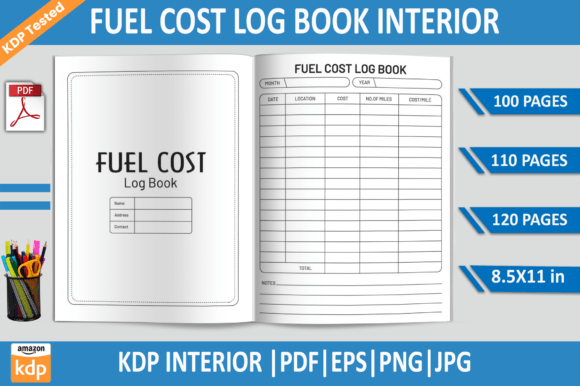
A typical fuel log page inside the Fuel Cost-log-book KDP Interior includes spaces for date, odometer reading, gallons or liters pumped, total cost, and price per unit. But the more effective interiors add columns for trip purpose (commute, business, personal, long haul), station name or location, and notes about driving conditions. This level of detail helps you distinguish between necessary operational costs and avoidable inefficiencies.
For example, if you notice that fill-ups at a certain station consistently cost more per gallon than others in the same area, you can adjust your route. Or if a particular driver in your fleet logs higher fuel consumption on similar routes, you can investigate whether the issue lies with driving habits, maintenance needs, or route planning. The interior becomes a diagnostic tool, not just a record.
Why the Interior Format Matters for Long-Term Use
The difference between a log book that gets used for three days and one that lasts a full year often comes down to the interior design. If the layout feels cramped, confusing, or irrelevant to the user's actual workflow, it gets abandoned. The Fuel Cost-log-book KDP Interior has been optimized through testing to ensure that each field serves a clear purpose and that the flow from one entry to the next feels intuitive.
The PDF files included in the package span 100, 110, and 120 pages, giving users flexibility in choosing a volume that matches their tracking frequency. A daily commuter filling up once a week might prefer the 100-page version for a full year of coverage, while a long-haul driver who refuels multiple times per week might choose the 120-page option for three to four months of detailed logs. The interior pages use a consistent header system across all lengths, so switching between versions feels seamless.
Size matters too. At 8.5 by 11 inches, each page offers enough room for handwritten entries without feeling oversized. The 300 DPI resolution ensures that printed lines remain crisp and that the PNG and JPG files reproduce cleanly if you need to extract a specific page for digital filing or backup. The EPS files provide editable vector layers, which is particularly useful if you want to customize the header or add your company logo before printing.
Bleed Settings and Print Readability
One of the overlooked details in log book design is the bleed setting. The Fuel Cost-log-book KDP Interior comes with a no-bleed layout, which means that content stays within safe margins regardless of how the book is trimmed. This is especially important for Amazon KDP printing, where slight variations in trimming can shift content closer to the edge than intended. By eliminating bleed, the interior guarantees that no data fields get cut off or obscured, and that the book looks professional when bound.
For creators who plan to sell this interior as a low-content or medium-content book on KDP, the no-bleed format simplifies the upload process. You do not need to worry about extending background colors to the edge or adjusting margins for different trim sizes. The tested files have already been checked on Amazon KDP to confirm that they meet the platform's quality standards, which reduces the risk of rejections or printing errors.
Practical Applications Across Different User Groups
The versatility of the Fuel Cost-log-book KDP Interior makes it applicable to a wide range of scenarios. For independent contractors, freelance delivery drivers, and rideshare operators, tracking fuel costs precisely is not optional; it is directly tied to profitability. The interior allows these users to separate business from personal mileage with clear field labels and enough space for trip notes that support tax deductions.
Small business owners with company vehicles use the log to allocate fuel costs to specific projects or clients. By maintaining a consistent record across all vehicles, they can compare fuel efficiency between different models, identify which drivers need additional training, and plan vehicle replacement schedules based on actual performance data rather than guesswork. The editable EPS files let them adapt the interior to their specific fleet numbering or department codes without starting from scratch.
For hobbyists and car enthusiasts, the log serves a different purpose. They track fuel consumption as part of overall vehicle health monitoring. A sudden drop in mileage can indicate a failing oxygen sensor, dirty injectors, or incorrect tire pressure. The detailed notes section allows them to correlate fuel data with maintenance events, which helps diagnose problems early and avoid expensive repairs.
Educators and researchers in automotive programs or transportation logistics use the interior format as a teaching tool. Students learn to collect, organize, and interpret real-world data. The consistent page layout makes it easy to compare entries across different vehicles and driving conditions, reinforcing lessons about fuel economy, cost analysis, and operational efficiency.
Comparing Digital and Paper Logging Approaches
While there are numerous smartphone apps for tracking fuel expenses, a paper log book offers advantages that digital solutions cannot replicate. There is no battery to drain, no app update that changes the interface, and no subscription fee to maintain access. The act of writing down each entry reinforces the habit and makes users more attentive to the data they record. Many users find that they remember trip details better when they write them by hand, which improves accuracy over time.
That said, the Fuel Cost-log-book KDP Interior does not force a choice between analog and digital. The high-resolution JPG and transparent-background PNG files allow users to scan completed pages and integrate them into spreadsheets or accounting software. Some users print the interior on loose-leaf paper and store it in a three-ring binder alongside digital printouts. The format adapts to whatever workflow the user prefers, rather than demanding strict compliance.
Design Considerations for KDP Creators and Publishers
Anyone who publishes low-content books on Amazon KDP understands the importance of interiors that pass the platform's review process. The Fuel Cost-log-book KDP Interior files have been tested specifically for this purpose. The PDF versions are flattened and print-ready, meaning no hidden layers, unembedded fonts, or transparency issues that could cause errors during production. The EPS files retain editability for creators who want to adjust spacing, add headers, or incorporate branding elements before generating their own PDF.
The multiple page counts (100, 110, and 120 pages) give publishers options for different price points and market segments. A 100-page book might retail at a lower entry price to attract budget-conscious buyers, while the 120-page version offers more value for users who anticipate heavy use. All three versions share the same interior grid, so customers who try one length are likely to purchase other lengths for different vehicles or time periods.
The 300 DPI resolution ensures that text and lines appear sharp even when printed on standard office paper or through KDP's print-on-demand service. The PNG files include transparent backgrounds, which is helpful if you want to overlay the log grid onto a colored or patterned cover template. The JPG files provide a quick preview option for testing layout alignment before committing to a final print run.
Customization Potential with EPS and Editable Files
Not every user needs the same fields. A fleet manager might want to add columns for vehicle ID number, driver name, and department code. A long-distance cyclist or motorcycle rider might prefer smaller page sizes or different unit measurements. The inclusion of EPS files allows users with Adobe Illustrator or similar vector software to modify the interior to match their exact requirements. You can resize the grid, adjust column widths, change fonts, or add new rows without degrading image quality.
This level of customization is rare in pre-made interiors. Most KDP-ready log books exist as flattened PDFs that cannot be altered without losing formatting. The editable EPS files give publishers and end users control over the final product, making the interior suitable for both commercial resale and personal adaptation.
Ensuring Long-Term Data Consistency
One of the biggest challenges in fuel tracking is maintaining consistency over months or years. When the interior format changes between pages or volumes, it becomes difficult to compare entries from different time periods. The Fuel Cost-log-book KDP Interior uses a uniform layout across every page, so the data structure remains stable from the first entry to the last. This consistency is critical when you export or transcribe the data into a spreadsheet for annual analysis.
Users who track fuel costs over multiple years benefit from this stability because they can identify trends that span vehicle life cycles. They can see how fuel efficiency changes as a car ages, how seasonal weather affects consumption, and how price fluctuations impact their annual budget. Without a consistent interior, these long-term patterns remain hidden in disjointed records.
Practical Tips for Maximizing the Interior's Value
To get the most out of the Fuel Cost-log-book KDP Interior, users should establish a routine that integrates logging into the refueling process. Keeping the book in the glove compartment or vehicle door pocket ensures it is always accessible. Filling in the odometer reading before starting the pump and completing the cost and gallon fields after the pump stops reduces the chance of forgetting details.
For business owners requiring driver compliance, pairing the interior with a simple policy sheet that explains how to complete each field reduces errors. The consistent layout means that training new drivers takes only a few minutes, and spot-checking entries becomes straightforward because every row follows the same format. The PDF versions can be printed in bulk for distribution across multiple vehicles, and the PNG files work well for digital submission if drivers photograph their completed pages for remote verification.
The interior also supports periodic reviews. Setting a monthly reminder to total the columns and calculate cost per mile helps users spot anomalies before they become budget problems. If a particular vehicle shows a sudden efficiency drop, the detailed notes section provides clues about potential causes, from tire pressure changes to route modifications. Over time, these reviews shift from reactive cost tracking to proactive fleet management.
Final Observations on Choosing the Right Interior Format
The Fuel Cost-log-book KDP Interior represents a specific approach to expense tracking that prioritizes detail, consistency, and usability over flashy design. Its strength lies in the thoughtful arrangement of fields, the flexibility of multiple page counts, and the print-ready quality that comes from KDP testing. Whether you are an individual looking to take control of your fuel budget, a business owner aiming to reduce fleet costs, or a publisher searching for a reliable interior to sell on Amazon, the format provides a solid foundation that can be adapted without losing its core functionality.
The availability of PDF, EPS, PNG, and JPG files means that you are not locked into one workflow. You can print directly from the PDF, edit the layout in Illustrator using the EPS, or incorporate the transparent PNG into a larger document or spreadsheet. The 8.5 by 11 inch size works with standard binders and printers, and the 300 DPI resolution ensures professional results regardless of the output method. For anyone serious about tracking fuel costs as a tool for better financial and operational decisions, this interior offers the structure needed to turn raw data into insight.