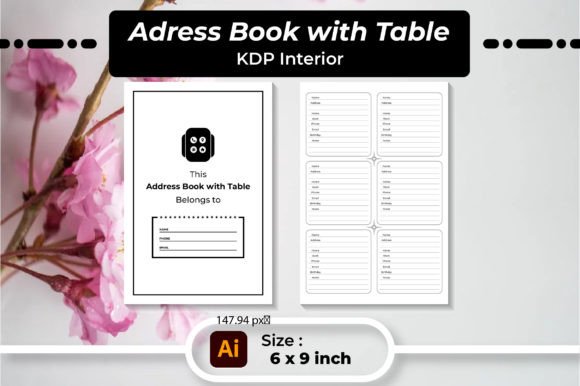
Address Book Organizer with Table: A Comprehensive Tool for Managing Contacts Efficiently
Managing personal and professional contacts has become increasingly complex in an era where communication spans multiple channels and devices. While digital address books are ubiquitous, many individuals and businesses still face challenges when they need a physical, sortable, and customizable record of their network. An Address Book Organizer with Table bridges the gap between traditional paper directories and modern digital management, offering a structured approach that caters to diverse organizational needs. This article explores how such a tool functions, its practical applications across different user groups, and why the Address Book with Table KDP Interior format has gained traction among content creators and end users alike.
Core Structure and Functional Design
At its essence, an address book organizer with a table format introduces a grid-based layout where each contact occupies a row, and columns represent specific data fields such as name, address, phone number, and email. This structure mimics a spreadsheet but exists on a printable, bound page. The table feature is not merely aesthetic; it enables users to visually scan, compare, and locate entries rapidly. When combined with alphabetical tabs or color-coded sections, the table layout transforms a simple list into a powerful reference system.
The Address Book with Table KDP Interior takes this concept further by providing a ready-to-use template that includes 120 pages of preformatted tables. Each page maintains consistent column widths and headings, ensuring that handwriting or typed entries align neatly. The 6x9 inch trim size strikes a balance between portability and legibility, making it suitable for desk use or carrying in a bag. With a 300 DPI resolution, printed text and lines remain crisp, which is especially important when users fill in fine details like email addresses or postal codes.
Key Data Fields and Customization Options
Standard columns in a table-based organizer typically include fields for full name, street address, city, state, zip code, phone numbers (home, mobile, work), and email. Some layouts also incorporate optional fields for birthdays, anniversaries, or notes. The editable source files provided with the KDP interior—including AI, EPS, SVG, and PNG formats—allow users or publishers to adjust column labels, add or remove fields, and change fonts. This flexibility means that a real estate agent might customize columns to include property interests, while a wedding planner could add sections for vendor categories and contract dates.
Real-World Applications Across User Groups
The versatility of an Address Book Organizer with Table makes it relevant for a wide spectrum of users. Below are several contexts where the table format offers distinct advantages over conventional address books or purely digital solutions.
Professionals and Business Owners
Consultants, freelancers, and small business owners often juggle contact lists for clients, suppliers, partners, and service providers. A table layout allows them to sort contacts by industry, last contact date, or geographic region. For example, a marketing consultant who maintains relationships with printing vendors, graphic designers, and copywriters can use the address book to quickly filter by service type if the organizer includes a column for category. While digital tools offer search functions, a physical book provides immediate access during meetings without worrying about battery life or screen glare.
Educators and Researchers
Teachers, professors, and academic researchers frequently connect with colleagues, publishers, grant officers, and students. A table-based organizer helps them maintain separate sections for professional contacts versus personal ones. For researchers managing multiple projects, adding a project name column to the table enables quick cross-referencing. The 100-page variant of the Address Book with Table KDP Interior is particularly useful for someone who needs a lightweight version for field research or conference travel.
Hobbyists and Community Organizers
Club leaders, volunteer coordinators, and event planners benefit from having a centralized record of members, donors, and volunteers. The table structure simplifies tracking membership expiration dates, dietary restrictions, or skill sets. A community garden organizer, for instance, could use the notes column to record each member's preferred planting zones or tool availability. Because the interior is print-ready and resizable, users can create multiple copies for committee members while maintaining a consistent format.
Creators and KDP Publishers
For individuals who sell low-content or no-content books on Amazon KDP, the Address Book with Table KDP Interior represents a marketable product. The included file set—AI, EPS, 2 SVG, 2 PNG, 2 high-quality JPG, and two PDF versions (120 pages and 100 pages)—gives creators everything needed to upload a polished listing. The editable source file means they can adjust the interior to match their brand colors or add a title page with their logo. Since the format is print-ready at 6x9 inches and 300 DPI, it meets Amazon's technical requirements without additional tweaking. This product appeals to buyers looking for a functional, attractive organizer that feels more substantial than a basic notepad.
Advantages of a Table-Based Address Book Over Alternatives
While many people rely on smartphone contacts or cloud-based CRM systems, a physical address book with a table layout offers several unique benefits that digital tools cannot replicate.
- No reliance on technology – Entries are accessible even without internet, power, or device functionality. This is critical during travel, power outages, or in settings where electronic devices are restricted.
- Enhanced privacy – Sensitive contact information remains offline, reducing exposure to data breaches or unauthorized digital access. For clients who handle confidential personal details, this is a significant consideration.
- Visual overview – A table allows you to see multiple contacts simultaneously, making it easier to compare entries, spot duplicate records, or identify missing fields. Digital lists often require scrolling or toggling between screens.
- Tactile interaction – Writing by hand can improve memory retention. Physically entering a new contact's details reinforces the information, which is beneficial for networking follow-ups.
- Customizable layout – Unlike preprinted address books with fixed fields, the editable files let users change column labels, add extra rows, or modify the table width. This adaptability is especially valuable for specialized use cases.
Implementation Workflow for End Users
Adopting an Address Book Organizer with Table involves a straightforward process that maximizes its utility over time. Start by determining how many contacts you need to record. If your network exceeds 500 entries, the 120-page version offers more space, while the 100-page version suits smaller lists. Next, decide whether to print the book at home, use a local print shop, or order a professionally bound copy. Because the files are provided in multiple formats, you can choose between printing on standard letter paper or having the 6x9 inch pages trimmed and bound.
Once the physical book is ready, fill in the columns consistently. For example, always write phone numbers with the area code in parentheses, and use a standard format for addresses. Some users find it helpful to create a legend on the first page, especially if they use abbreviations in the notes column. After populating the book, use alphabetical dividers or sticky tabs to speed up lookup. The table format also allows you to periodically review the list and mark inactive contacts without deleting them, preserving a historical record.
Transitioning from Digital to Physical
For those currently using a digital address book, migrating to a table organizer does not require starting from scratch. Export your contacts to a CSV file, then use the editable AI or EPS file to map the data fields to the table columns. Print a draft copy to verify formatting, then finalize the book. This hybrid approach lets you enjoy the benefits of a physical organizer while leveraging existing digital records. Some users maintain both versions, using the digital system for daily updates and the physical book for long-term reference and backup.
Considerations When Choosing a KDP Interior Address Book
Not all address book interiors are created equal. The Address Book with Table KDP Interior stands out because of the file variety and print specifications, but buyers and publishers should evaluate a few factors to ensure the product meets their needs.
Paper Quality and Binding
Even with a well-designed interior, the physical quality of the printed book depends on paper thickness and binding type. For a 6x9 inch book, users should choose paper that handles ink without bleeding, especially if they plan to write with fountain pens or markers. Coil binding allows the book to lie flat, which is convenient when entering data across a full spread. The 300 DPI resolution ensures that lines and text remain sharp regardless of the printing method.
Page Count and Capacity
With 120 pages, the organizer can hold approximately 300 to 400 entries if each page contains three rows and you use both sides. The 100-page version offers slightly less capacity but may be preferable for users who want a slimmer book. Consider how quickly your contact list grows. If you attend many networking events, opt for the larger version or use one page per letter of the alphabet to allow for expansion.
Editable Source Files
Having access to AI, EPS, and SVG files means that users can open the template in vector editing software and modify every element. This is especially useful for publishers who want to rebrand the interior or add unique decorative elements. The PNG and JPG files serve as quick previews or cover images for online listings. If you are not comfortable with design software, the preformatted PDF files are ready to print immediately, removing any technical barriers.
Trends in Low-Content Publishing and Address Books
The rise of low-content and no-content publishing on platforms like Amazon KDP has made it easier for creators to offer specialized organizers. Address books with table interiors are part of a broader shift toward functional printables that serve specific organizational needs. Unlike generic address books, the table format appeals to users who value data management principles—sorting, filtering, and categorizing—even in a physical format. As remote work and freelancing continue to grow, demand for portable, offline contact management tools is likely to persist.
Additionally, the editable nature of this interior aligns with the increasing expectation for customization. Consumers want products that adapt to their workflow rather than forcing them into a predefined structure. By providing source files in multiple formats, the Address Book with Table KDP Interior empowers users to tailor the layout to their exact preferences, whether that means adding columns for social media handles, emergency contacts, or time zone offsets.
Future Potential for Integration
Looking ahead, we may see address book organizers that combine printed tables with digital elements, such as QR codes that link to online profiles or companion apps for backup scanning. For now, the straightforward table approach remains highly effective because it requires no learning curve. Anyone who has used a spreadsheet can immediately understand and utilize the layout. This simplicity, combined with the flexibility of editable files, positions the Address Book Organizer with Table as a lasting tool in both personal and professional settings.
In summary, an address book that relies on a table structure offers a pragmatic solution for anyone who needs to manage contacts in a tangible, sortable, and customizable way. Whether you are a busy professional, a content creator looking for a reliable KDP interior, or a community volunteer organizing a membership list, the table format enhances clarity and accessibility. With print-ready specifications, a practical trim size, and multiple file options, this organizer meets the demands of a broad audience while remaining grounded in the timeless value of an orderly address book.