20 USD Saving Challenge: A Practical Savings Tracker for Real Results
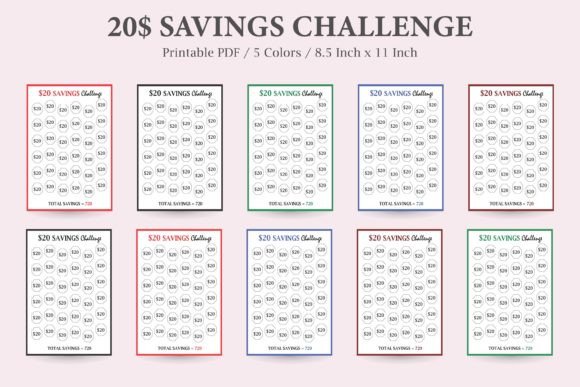
Building a savings habit often feels abstract until you attach it to a concrete system. The 20 USD Saving Challenge paired with a dedicated Savings Tracker provides exactly that: a clear, repeatable structure that turns intention into measurable progress. Designed to help you accumulate $720 by saving $20 at a time, this challenge breaks down a significant financial goal into manageable, consistent actions. It is part of a broader category of under-$100 savings challenges, making it accessible across income levels, ages, and financial backgrounds—from teenagers learning to manage allowance to adults seeking a low-friction way to build an emergency fund or a targeted savings pool.
How the 20 USD Saving Challenge Fits into a Broader Financial Workflow
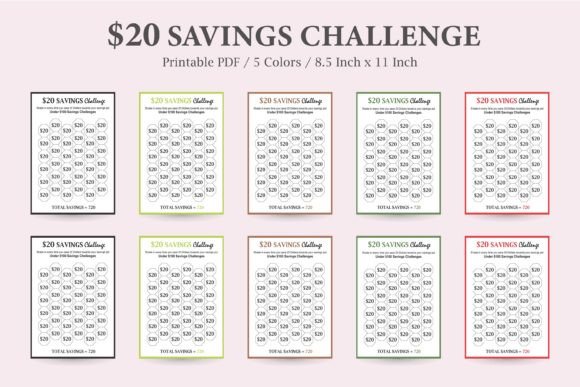
The challenge works as a standalone exercise or as a component within a larger personal finance system. Before committing to a major purchase, funding a side project, or building a buffer for tax season, integrating this challenge creates a dedicated savings stream without disrupting existing budgets. Its 36-box format, typically completed over 36 days (or any custom timeframe), allows you to run it in parallel with other financial tools such as budgeting apps, expense tracking spreadsheets, or envelope systems.
During a project—whether you are launching a small product, saving for professional certification, or setting aside money for a home renovation—the tracker serves as a visual anchor. Each time you place $20 into your savings jar or mark a box on the chart, you reinforce the connection between disciplined saving and eventual project funding. After completing a purchase or financial goal, the same tracker can be reused for the next objective, making it a repeatable asset rather than a one-time printable.
What the 20 Dollar Saving Challenge Tracker Includes
The printable includes a single-page chart featuring 36 numbered boxes. Each box represents a $20 deposit. When all boxes are filled, your total saved reaches $720. The design is clean and practical: a standard 8.5-inch by 11-inch layout that fits easily into a binder, planner, or notebook. No complex instructions are required—just mark, color, or check off a box each time you add $20 to your savings. This simplicity is intentional; it reduces friction and encourages consistent use.
You can pair the tracker with a physical savings jar, a dedicated bank sub-account, or a digital envelope system. The visual progress—watching empty boxes turn into filled ones—provides motivation that a spreadsheet row alone often lacks. For those who prefer a hybrid approach, the tracker works alongside a standard budget spreadsheet or a savings app like Qapital or YNAB, where you track the equivalent deposits digitally and update the chart weekly.
Key Features of the Savings Challenge Chart
- 36 savings increments of $20 each, requiring no math or variable amounts.
- Total savings goal of $720, achievable in just over a month or at your own pace.
- Single-page, no-frills design optimized for quick reference and low cognitive load.
- Printable format that works with any standard printer and paper type.
- Reusable for multiple savings cycles—print once, save repeatedly.
Practical Implementation: Integrating the Tracker into Your Routine
To get the most out of the 20 Dollar Saving Challenge, treat it as a weekly or biweekly ritual. Decide on a consistent trigger: every payday, every Monday morning, or every time you complete a specific work milestone (e.g., finishing a client project or publishing a newsletter). Place the chart somewhere visible—on your desk, inside your planner, or on the refrigerator door. Each time you deposit $20, physically mark the corresponding box. This act of manual tracking reinforces the habit far more than an automatic transfer alone.
For professionals and freelancers with irregular income, the challenge offers flexibility. You can skip weeks when cash flow is tight and double up during stronger months. The 36-box structure does not impose a strict calendar, making it suitable for anyone whose income fluctuates. Simply keep the chart on hand and fill boxes as funds become available. Over time, you will complete the challenge at your own rhythm, without the pressure of a rigid deadline.
Example Workflow for a Freelancer or Small Business Owner
- Set up your tracker at the start of a new quarter or project phase. Print the chart and place it inside your work binder or digital notebook.
- Link the challenge to a specific income stream. For example, save $20 from every invoice paid. When a client sends a payment, immediately transfer $20 into your savings jar or sub-account and mark the next available box.
- Monitor progress weekly. Every Friday, review how many boxes you have filled. If you fell short, adjust by setting aside a slightly larger amount from the next invoice or by reducing a non-essential expense that week.
- Celebrate completion. When all 36 boxes are marked, you have $720 available. Decide in advance where this money will go—emergency fund, equipment upgrade, marketing spend, or professional development. The clarity of purpose increases your motivation to follow through.
How the Savings Tracker Interacts with Other Tools and Methods
The chart complements several common personal finance methods. If you follow the 50/30/20 budget rule, the $20 challenge fits neatly into the 20% savings category without requiring complex reallocation. For those using the envelope system, the tracker can serve as a visual summary for one specific envelope (e.g., "Emergency Savings" or "Vacation Fund"). You can also pair it with a digital budgeting app by setting up a recurring $20 transfer and using the printed chart as a progress dashboard.
For parents and educators teaching financial literacy, the challenge is a tangible way to demonstrate the power of consistency. Kids and teens can see that small, repeated actions accumulate into a meaningful sum. The chart provides a clear before-and-after snapshot, making it easier to discuss concepts like delayed gratification, goal setting, and the difference between saving and spending.
Preparation, Compatibility, and Long-Term Use
Preparation is minimal: download the PDF, print it on standard letter-size paper, and decide where to store the physical savings. You can use a simple jar, a dedicated envelope, or a separate bank account. No special apps, subscriptions, or financial expertise are required. The chart works equally well for individuals who prefer analog systems and for those who digitize everything. If you want a digital version, scan the printed chart or recreate it in a spreadsheet—though the act of physically marking a box often has a stronger psychological effect.
Over the long term, the challenge can be repeated indefinitely. Once you complete 36 boxes, print a fresh chart and start a new cycle. You can stack multiple charts for larger goals, such as saving $1,440 by running two challenges concurrently. The system scales naturally because the unit size ($20) remains constant, and the tracking method stays identical. This repeatability is what makes the 20 Dollar Saving Challenge a sustainable practice rather than a one-time novelty.
Usability Considerations for Different Budgets and Lifestyles
- Full-time professionals: Automate the $20 transfer on payday and mark the chart monthly. The low amount makes it nearly invisible in the budget, yet the total adds up quickly over 36 deposits.
- Students and young adults: Use the chart to save from part-time work, allowance, or gift money. The 36-box goal is achievable within a semester or summer break, providing a practical lesson in financial planning.
- Entrepreneurs and creatives: Tie savings to specific project milestones. For example, save $20 for every 100 newsletter subscribers gained or every product sale. This links the challenge directly to business outcomes.
- Households on a tight budget: The challenge works even on limited income because $20 per interval is low. Stretch the timeline to 12 or 18 weeks, saving less frequently but still completing the chart over time.
Observations on Consistency and Quality Control
Consistency matters more than speed. The tracker is designed to encourage regular deposits, but its flexibility means you do not have to stick to a rigid schedule. If you miss a week, simply resume the next time you have $20 available. The visual progress will still accumulate, and the goal remains intact. This adaptability reduces the likelihood of abandoning the challenge altogether—a common pitfall with rigid financial programs.
Quality control, in this context, refers to how well the system holds up over multiple uses. The printable is a static document, so its longevity depends on your storage method. Laminating the chart or placing it in a clear sleeve allows you to reuse it with a dry-erase marker across several savings cycles. If you prefer a fresh copy each time, keep the PDF on your device and print as needed. Both approaches are valid; choose the one that aligns with your preference for permanence versus novelty.
Final Thoughts on Integrating the 20 USD Saving Challenge into Your Workflow
The 20 USD Saving Challenge and its accompanying Savings Tracker fill a specific niche: a low-entry, high-visibility method for building savings without behavioral complexity. Whether you are a freelancer managing variable income, a parent teaching money skills, or a professional seeking a simple way to fund a future expense, this system delivers practical results. Its strength lies not in novelty but in repeatability—you can run it, complete it, and start again with minimal overhead. Print the chart, set your first $20 aside, and let the tracker guide you through the rest. The $720 total is real, but the habit you build along the way is the larger return.