Choosing the Right Bank Balance Logbook: A Practical Guide to Templates and Alternatives
Tracking your finances with a physical logbook may seem like an old-fashioned habit in an era of apps and spreadsheets, but many people find that writing down their bank balance by hand brings a level of clarity and accountability that digital tools cannot match. A Bank Balance Logbook gives you a dedicated space to record deposits, withdrawals, and running totals without the distractions of notifications or the complexity of budgeting software. However, not all logbooks are created equal. The raw materials you start with—whether a pre-designed template, a blank notebook, or a homemade grid—shape how useful and sustainable your tracking habit becomes.
This article walks through the key considerations when choosing a bank balance logbook, with a close look at one particular template package that offers flexibility for self-publishers and individual users alike. By understanding the tradeoffs, you will be better equipped to select a format that actually supports your financial routines rather than collecting dust on a shelf.
What a Bank Balance Logbook Template Offers
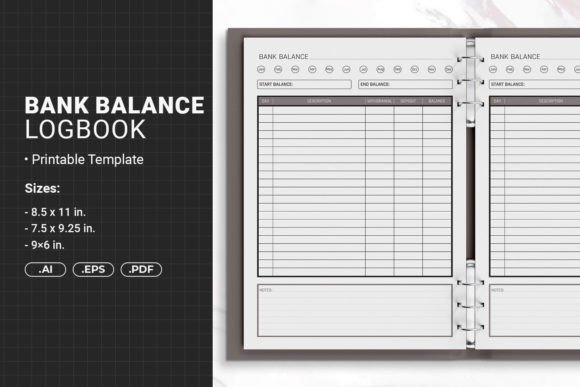
A Bank Balance Logbook template is essentially a pre-laid-out framework for recording account activity. Instead of drawing your own columns and rows each time, you print pages that already include headings for date, description, debit, credit, and balance. The template package described here goes a step further: it provides editable source files in Adobe Illustrator (AI), EPS, and PDF formats, plus three distinct sizes to match different binding and portability preferences—8.5 x 11 inches (letter), 7.5 x 9.25 inches, and 6 x 9 inches.
What makes this package distinct is not the concept of a logbook itself, but the level of production polish and flexibility it gives to both personal users and self-publishing authors. The files are ready for print or upload to Amazon KDP with bleed, which means you can order a single copy for yourself or publish it as a commercial product without needing to design from scratch. The inclusion of safe margins for hole punching also means you can place the pages in a binder and rearrange them as needed—a feature that matters more than most people initially realize.
Comparing a Pre-Built Template with Other Approaches
When you decide to keep a written bank balance log, you essentially have three paths: buy a finished journal, build your own from scratch using blank paper, or start from a template like this one. Each approach carries its own set of benefits and limitations.
Ready-Made Journals vs. Customizable Templates
A finished journal from a bookstore or online retailer offers convenience—you open the cover and start writing. The downside is that you are locked into that publisher’s layout, paper quality, and size. If you prefer a specific column width, additional notes sections, or a particular page count, you may have to settle for what exists on the market.
A Bank Balance Logbook template, by contrast, puts the design choices in your hands. You can adjust fonts, add or remove fields, change the spacing for larger handwriting, or even insert your own cover art before printing. For someone who values control over the final product, this is a meaningful advantage. The tradeoff is that you need to invest a small amount of time in customizing and printing—or in uploading the file to a print-on-demand service if you plan to sell copies.
DIY Hand-Drawn Pages vs. Clean Print Layouts
Drawing your own ledger lines in a blank notebook is the most flexible and lowest-cost option. You can adapt the format weekly, add new columns when needed, and use any notebook you already own. Yet this approach has a hidden cost: friction. When you sit down to record a transaction, a messy or cramped page can discourage consistency. Over time, poorly aligned columns and inconsistent spacing make it harder to double-check your arithmetic at a glance.
A professionally designed template eliminates that friction. The columns are evenly spaced, the headers are clear, and the page layout follows a consistent structure from start to finish. For someone who tracks multiple accounts or reconciles their logbook against bank statements, that consistency saves time and reduces errors. The template package mentioned here also includes multiple size options, so you are not forced to use a large letter-size sheet if you prefer a compact 6 x 9 inch book that fits in a bag or drawer.
Strengths and Practical Tradeoffs of the Template Package
Understanding what a template excels at—and where it may fall short—helps you decide whether it fits your actual workflow.
Strengths: Professional Finish, Adaptable Formats, and Print Readiness
The most obvious strength is the professional look. Even if you have strong design skills, creating a polished layout from scratch takes hours. This package provides multiple file types (AI, EPS, PDF), so you can edit in the software you already use or simply print the PDF as-is. The inclusion of bleed margins is especially relevant for anyone using Amazon KDP, because books uploaded without proper bleed get rejected or produce unsightly white edges after trimming.
Another practical strength is the range of sizes. A 6 x 9 inch logbook is portable and fits neatly on a desk or in a small drawer. The 8.5 x 11 inch version gives you more room for detailed entries, which matters if you write long descriptions or need to include check numbers and running balance calculations. The 7.5 x 9.25 inch option sits between the two—close to a standard trade paperback size, which some users find just right for daily use without feeling either cramped or oversized.
The safe margin for hole-punching binding is also worth highlighting. Many users prefer to keep their logbook in a three-ring binder so they can remove old months, insert new pages, or carry only the current month’s section. A template that accounts for this margin avoids the frustration of punching through text or numbers.
Tradeoffs and Limitations
No single template suits every financial tracking style. If you prefer to log expenses in categories, track multiple bank accounts on the same page, or include a column for check number or transaction type, you will need to customize the layout—which the AI and EPS files allow, but only if you have access to Adobe Illustrator or a compatible vector editor. Users who do not own that software will rely on the PDF version, which is ready to print but not easily modified.
Another tradeoff is paper choice. When you print your own logbook, you control the paper weight and finish, but you also handle the printing and binding (or pay a service to do it). Some users prefer the feel of a commercially bound journal and are willing to sacrifice customization for that tactile quality. If the convenience of a finished product outweighs your need for personalization, a template may feel like extra overhead.
Additionally, the template package assumes a specific layout style—one that works well for individuals tracking personal accounts. If you are managing business accounts, multiple currencies, or complex reconciliation workflows, you may need a more specialized ledger design with additional columns for reference numbers, tax categories, or running totals per account. In those cases, a general-purpose bank balance logbook template would need significant modification to match your requirements.
When Is a Customizable Template the Right Choice?
A Bank Balance Logbook template like the one described here is particularly well suited for three common scenarios:
- Self-publishing authors who want to create a low-content book for KDP or other print-on-demand platforms. The file includes bleed and safe margins, so the technical steps are already handled. You can focus on the cover design and listing details.
- Individuals who test different layouts before settling on a permanent logbook format. Because you can print a few pages and adjust the spacing, you avoid the cost of buying multiple pre-bound journals that end up unused.
- Users who prefer ring-bound or disc-bound systems for their financial records. The punch-hole-safe margin means you can place the pages into any standard binder without losing content.
For someone who just wants to start tracking today with minimal effort, a ready-made journal from a store may be the faster path. But if you anticipate wanting to change the layout later, or if you plan to produce multiple logbooks for different accounts or family members, the template gives you a reusable foundation that you can adapt as your needs evolve.
When Another Option Might Suit You Better
If you do not own software to edit vector files and you are content with a simple ledger, a free printable PDF from a personal finance website may meet your needs without the upfront cost. Many such resources exist, though they often lack the production polish needed for commercial use or the three-size flexibility of a paid package.
If you are a spreadsheet enthusiast, you might find that a digital tracker in Excel or Google Sheets serves you better than any printed logbook. Digital tracking allows for automatic calculations, search, and long-term data analysis. The downside is screen fatigue and the loss of the tactile, deliberate experience that draws many people to a physical logbook in the first place.
If you value portability above all else, a pocket-sized notebook with hand-drawn columns may be the lightest and most accessible option. You can buy one at any stationery store and start immediately. The tradeoff, as noted earlier, is that your layout will vary from page to page, which can become a small but persistent source of friction over months of use.
Key Decision Factors to Consider
To decide whether this type of template package aligns with your needs, ask yourself the following questions:
- How much time do you want to invest in setup? Editing files in Illustrator takes some upfront effort, but after that, you have a permanent template you can reuse. If you prefer immediate use, the included PDF is ready to print today.
- What size and binding work best for your routine? Think about where you will store the logbook and how often you will carry it. The three sizes in this package give you real flexibility, but only if you choose the one that fits your physical space.
- Do you need to modify the layout? If your tracking style calls for additional columns or a different arrangement, the AI and EPS files are essential. Without them, you are limited to the pre-set PDF design.
- Are you creating a product to sell? If so, the print-ready format with bleed saves you from technical rejections and speeds up your publishing workflow. This is one area where a well-prepared template clearly outperforms a generic free printable.
Making an Informed Choice
A Bank Balance Logbook template is not a magic solution that guarantees financial discipline—no tool is. What it does offer is a structured starting point that removes many of the small obstacles that can derail a tracking habit. The package described here distinguishes itself through multiple formats, three size options, and production-ready features that serve both personal use and self-publishing.
If you value the ability to customize, print exactly what you need, and control the physical format of your logbook, a template like this is worth serious consideration. On the other hand, if you prefer the immediacy of a pre-bound journal or the automation of a digital tracker, another route may prove more natural for your habits.
The best choice ultimately depends on how you work, where you keep your records, and whether you see yourself sticking with a handwritten log for more than a few weeks. By weighing the strengths and tradeoffs outlined here, you can select a bank balance logbook that genuinely supports your financial awareness rather than becoming just another abandoned notebook on the shelf.