Weekly Habit Tracker Printable Template: Build Consistency With Purpose
Most people overestimate what they can accomplish in a day and underestimate what they can accomplish in a week. That gap between expectation and reality is where habits either take root or fall apart. A Weekly Habit Tracker Printable Template is one of the simplest tools you can use to close that gap, but only if you approach it with intention. This is not about checking boxes for the sake of checking boxes. It is about creating a structure that turns small daily actions into measurable progress toward your goals.
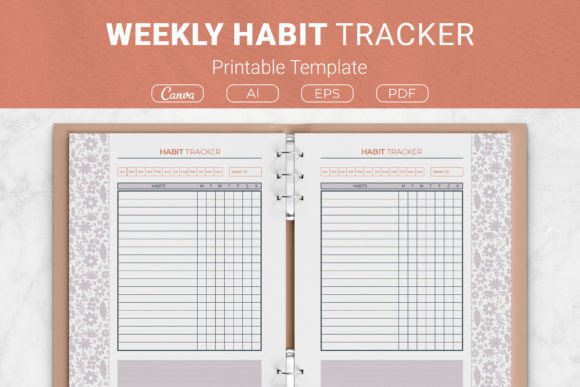
Whether you are an entrepreneur building a business, a creator developing a body of work, or a professional managing competing priorities, the ability to track habits weekly gives you a rhythm that daily tracking alone cannot. A week is long enough to see patterns and short enough to correct course before momentum is lost. The template you choose should reflect that balance. The Weekly Habit Tracker Printable Template, available in AI, EPS, PDF, and Canva formats, offers flexibility across US Letter, A4, and other popular sizes, making it suitable for both personal binders and KDP publishing projects.
Why a Weekly View Matters More Than a Daily One
Daily habit tracking can feel like a grind. You check a box, the day ends, and you repeat. Over time, the feedback loop weakens because the time horizon is too short to reveal meaningful trends. A weekly habit tracker shifts your focus from individual actions to consistent patterns. You begin to ask better questions: Did I do this habit three times or five times this week? What got in the way on Tuesday? What worked on Thursday?
When you use a Weekly Habit Tracker Printable Template consistently, you train yourself to think in terms of frequency and recovery rather than perfection. If you miss a day, you have six more opportunities that week to rebuild your streak. This reduces the all-or-nothing thinking that derails many people within the first few weeks of a new habit. Instead of feeling like you failed because you missed one morning, you see the full week and recognize that four out of seven is still progress.
Aligning Your Habits With Strategic Goals
A habit tracker is only as useful as the habits you put into it. Many people fill in the left column with generic items like "exercise" or "read" without connecting those actions to a larger outcome. That approach works for casual use, but if you are looking for long-term results, you need to think strategically about what belongs on that list.
Start by identifying two or three goals that matter most to you this quarter. Then break each goal into weekly behaviors. If your goal is to launch a new product, your weekly habits might include "write 500 words of copy," "review competitor positioning," and "test one marketing channel." If your goal is to improve operational efficiency in your small business, your habits might include "review weekly metrics," "delegate one task," and "spend 30 minutes on process documentation."
The Weekly Habit Tracker Printable Template becomes a tactical document when you treat it that way. Every box you check is evidence that you moved closer to a specific outcome. When you look back at the end of the week, you are not just seeing which habits you kept. You are seeing which actions actually advanced your work.
Practical Example: A Week of Focused Execution
Let us say you are a freelance creator who wants to build a more consistent content schedule. Your weekly habits might include:
- Outline one article idea each morning
- Write for 45 minutes without distractions
- Repurpose one piece of content for social media
- Engage with three audience comments or questions
- Review analytics once at the end of the week
Listing these habits on your template gives you a clear daily agenda. Each morning, you know exactly what to do without deciding again. By the end of the week, you can see whether your output matched your intention. If you consistently miss one habit, you have data to decide whether to adjust your approach or replace that habit with something more realistic.
How to Use a Weekly Habit Tracker Without Falling Into Over-Tracking
One risk of using any tracker is that you start tracking everything. You fill the left column with ten, fifteen, or twenty habits, and then you feel overwhelmed before the week even starts. That defeats the purpose. A Weekly Habit Tracker Printable Template works best when you limit yourself to a manageable number of habits. Five to seven is a practical range for most people. This keeps your focus narrow enough that each habit receives real attention.
Another common mistake is tracking habits that are too vague. "Eat healthier" is not a habit you can check off. "Eat vegetables with lunch" is. "Be more productive" is not trackable. "Work on top priority task for 25 minutes" is. When you define your habits with clarity, the tracker becomes a reliable source of feedback rather than a source of confusion.
Consider also the timing of your review. The real value of a weekly habit tracker emerges during your end-of-week reflection. Set aside ten minutes on Friday or Sunday to look at your completed template. Ask yourself three questions:
- Which habits did I do consistently, and what conditions supported that consistency?
- Which habits did I skip most often, and what was the underlying reason?
- Do the habits I tracked still serve my current priorities, or should I replace some?
This simple review turns a printable template into a strategic tool. Without it, the tracker is just a record. With it, you are actively refining your system each week.
Customizing the Template for Your Context
The Weekly Habit Tracker Printable Template comes with editable files in AI, EPS, and Canva formats. That means you can modify the layout to fit your specific workflow. If you prefer to track habits by time of day rather than just by day of the week, you can adjust the columns. If you want to add a notes section at the bottom for weekly reflections, you can include that. The ability to customize the template makes it useful for different contexts, from personal development to client work to KDP publishing.
For publishers and content creators, this template can be used as a planner interior for Kindle Direct Publishing projects. The multiple size options, including 7.5 x 9.25 inches and 6 x 9 inches, give you flexibility depending on your target audience and format. When designing a planner, the habit tracker becomes a core spread that users return to week after week. The cleaner and more intuitive the layout, the more value it provides to the end user.
Strategic Considerations for KDP Publishers
If you are publishing a weekly planner or productivity journal, the habit tracker spread is often the section that gets the most use. Buyers are looking for structure that helps them follow through on their intentions. A well-designed Weekly Habit Tracker Printable Template that balances simplicity with enough space for multiple habits will perform better than a crowded or overly complex design.
When selecting a template for your KDP project, consider the following:
- Does the layout allow enough writing space for each day?
- Is the habit column wide enough for longer habit descriptions?
- Does the design support both personal and professional use cases?
- Are the file formats compatible with your publishing workflow?
The template offered here includes AI, EPS, PDF, and Canva links, so you can adapt it to your production pipeline without starting from scratch. That saves time and ensures consistency across your planner products.
Potential Pitfalls and How to Avoid Them
No tool is foolproof, and a habit tracker is no exception. One of the most common risks is using the tracker as a performance scorecard rather than a learning tool. When you treat unchecked boxes as failures, you are less likely to keep using the tracker over time. The purpose is not to achieve a perfect week. The purpose is to see where you are and decide what to do next.
Another risk is relying on the tracker without an underlying system. If you do not have a clear reason for why you are tracking a particular habit, the template becomes busywork. Before you write anything in the left column, ask yourself: What will this habit enable me to do that I cannot do now? If you cannot answer that question, reconsider whether that habit belongs on your list.
Finally, avoid using the same set of habits for months without revisiting them. As your goals evolve, your weekly habits should evolve too. A habit that served you well during a product launch may be irrelevant during a maintenance phase. Review your tracker at the start of each month and make adjustments based on what you have learned.
Long-Term Value of Consistent Weekly Tracking
Over time, the act of tracking habits weekly builds a skill that extends beyond the template itself. You become better at estimating what you can realistically accomplish. You develop a sense of how long it takes for a new behavior to become automatic. You also build a personal record of your own patterns, which is invaluable for decision-making.
For entrepreneurs and small business owners, this translates directly into operational improvements. When you track habits related to client outreach, financial reviews, or team communication, you create a feedback loop that prevents small issues from becoming recurring problems. For creators and freelancers, tracking habits around content production, skill development, and client work helps you maintain consistency even during busy periods.
The Weekly Habit Tracker Printable Template is not a magic solution. It will not force you to act. But when used deliberately, it provides a structure that makes consistent action easier. It removes the mental load of deciding what to do each day and replaces it with a simple visual system that shows you, week by week, whether your daily choices align with your long-term goals.
Making the Decision to Start
If you are considering using a weekly habit tracker, the best time to begin is the next week. Pick a template that fits your preferred size and format. The printable versions offer immediate access, while the editable files give you room to customize before printing. Start with three to five habits that are directly tied to one meaningful goal. Track for two weeks, then review what you have learned.
The Weekly Habit Tracker Printable Template is designed to support both personal use and commercial publishing projects. Whether you print it for your own binder or include it in a planner you are preparing for KDP, the structure is flexible enough to adapt to your specific needs. The key is to use it with purpose. Let the template hold you accountable, but let your goals guide what goes into it.
Consistency is not built in a day. It is built in weeks that add up to months, and months that add up to years. A simple printed tracker, used with regular reflection, can be one of the most effective ways to make that process visible and sustainable.